Review: The Phoenician Scheme (2025) – Wes Anderson’s Stylish, Sharp-Tongued Ode to Power and Legacy
Wes Anderson’s films are instantly recognizable—symmetrical frames, whimsical color palettes, and ensemble casts navigating quirky, heartfelt stories about family, loss, and connection. Yet with The Phoenician Scheme (2025), the auteur takes his signature style and infuses it with a sharp, corrosive edge, delivering a film that feels both familiar and daringly new. Co-written with longtime collaborator Roman Coppola, this black comedy-crime thriller centers on Anatole “Zsa-Zsa” Korda (Benicio del Toro), a ruthless European arms dealer and industrialist whose grand, mysterious plan sparks chaos, assassination attempts, and a fragile reconciliation with his estranged daughter Liesl (Mia Threapleton), a devout Catholic novice. Nominated for the Palme d’Or at the 2025 Cannes Film Festival, The Phoenician Scheme is a meticulously crafted, darkly humorous exploration of power, legacy, and the moral emptiness of unchecked ambition—one that showcases Anderson’s evolving storytelling while staying true to the idiosyncrasies that have made him one of cinema’s most beloved filmmakers. With its star-studded cast, striking visuals, and biting social satire, the film is a must-see for Anderson fans and cinephiles alike, even as it occasionally stumbles under the weight of its own complexity.
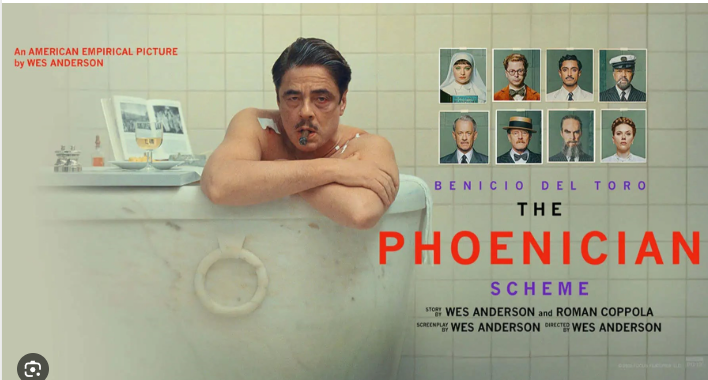
Set in 1950, The Phoenician Scheme opens with a striking, slow-motion overhead sequence in a hospital bathroom, where Zsa-Zsa Korda narrowly survives his sixth assassination attempt. Played with decaying charisma by Benicio del Toro, Zsa-Zsa is a jaded oligarch—one of Europe’s wealthiest men, with fingers in arms dealing and aviation—who carries the weight of power like a well-tailored suit: sharp, imposing, and ultimately empty. Weary of constant threats and eager to execute his “Phoenician Scheme”—a mysterious infrastructure project shrouded in secrecy—he decides to name his daughter Liesl as his sole heir, a choice that baffles everyone around him. Liesl, portrayed with restrained sorrow by Mia Threapleton, is a world away from her father’s cutthroat world: a soon-to-be nun who lives in a convent, she exists in a moral universe entirely separate from Zsa-Zsa’s greed and manipulation. Their uneasy reunion forms the emotional core of the film, as Zsa-Zsa attempts to reconcile with the daughter he abandoned, while Liesl grapples with the conflict between her faith and the legacy her father is forcing upon her.
Anderson’s greatest strength here is his refusal to reduce Zsa-Zsa to a one-note villain. Instead, he crafts a complex anti-hero—imperious, unreadable, and haunted by the realization that his power has cost him his humanity. Del Toro delivers a career-defining performance, balancing Zsa-Zsa’s arrogance with quiet vulnerability; in one pivotal scene, he casually mentions that his Phoenician Scheme will employ slave labor, his tone as nonchalant as if discussing the weather, while the camera holds steady, refusing to flinch from the moral horror of his words. It’s a chilling moment that underscores Anderson’s critique of the ultra-wealthy: men who treat human life as just another commodity to be managed, their moral enormity hidden behind meticulously arranged lives and polished personas. Threapleton, meanwhile, shines as Liesl, bringing depth to a character who could have easily been reduced to a symbolic figure. Her performance flickers with quiet resolve as Liesl navigates the tension between her devotion to God and her complicated love for a father who embodies everything she rejects.

The supporting cast is a who’s-who of Anderson regulars and A-list talent, each bringing their own quirks to the film’s chaotic tapestry. Michael Cera delivers his best performance to date as Björn, a quirky private tutor hired to prepare Liesl for her role as heir. Cera’s signature deadpan humor is on full display, but he adds layers of quiet subversion, making Björn more than just a comedic sidekick—he’s a subtle voice of reason in a world gone mad. His scenes with Richard Ayoade, who plays a disgruntled militia leader in the jungle, crackle with an anti-naturalistic rhythm that fits perfectly within Anderson’s stylized world. Jeffrey Wright shines as a fast-talking ship captain with a penchant for absurdity, while Tom Hanks and Bryan Cranston make brief but memorable appearances as scheming tycoons determined to stop Zsa-Zsa’s plan. Scarlett Johansson, though in a small role as a glamorous spy with her own agenda, brings a sharp wit and icy poise that elevates every scene she’s in, while Benedict Cumberbatch delivers a menacing turn as a rival arms dealer whose obsession with Zsa-Zsa borders on obsession. Even with its sprawling ensemble, Anderson gives each character moments to shine, never letting star power overshadow the story’s emotional core.
Visually, The Phoenician Scheme is a masterclass in Anderson’s evolving aesthetic—one that trades his usual saturated pastels for a more subdued, morally charged palette. With longtime collaborator Robert Yeoman replaced by Bruno Delbonnel as cinematographer, Anderson adopts a 1.5:1 aspect ratio that compresses the frame into a visual theater, each shot resembling an overdetermined diorama. The color scheme is dominated by dusty ochres, foggy grays, and sun-bleached deserts, echoing the moral weariness of the film’s characters. Production designer Adam Stockhausen’s opulent sets are unmistakably Anderson-esque—symmetrical, meticulously detailed, and filled with hidden meaning—but they feel overmanaged, as if each location is silently suffocating under its own perfection. Props are no longer just decorative flourishes; they’re arguments: hand grenades are passed around like dinner mints, million-dollar business deals hinge on playground basketball games, and real Renoir paintings hang beside obvious fakes, commenting on the emptiness of authenticity in a world driven by greed.
Musically, the film is elevated by Alexandre Desplat’s score, which leans into Stravinsky’s influence, centering motifs from The Firebird and Apollo. Desplat’s music is both whimsical and menacing, perfectly capturing the film’s tonal balance of black comedy and thriller. The soundtrack also includes vintage European jazz and classical pieces, which Anderson weaves into the narrative with his usual precision—a mournful violin solo underscores a tense conversation between Zsa-Zsa and Liesl, while a bouncy jazz tune plays over a scene of characters plotting murder, creating a jarring contrast that heightens the film’s dark humor. Sound design is equally meticulous: the click of a revolver, the rustle of a nun’s habit, and the distant hum of a private jet all blend to create a world that feels both hyper-stylized and eerily real.
What sets The Phoenician Scheme apart from Anderson’s earlier work is its unflinching critique of power and wealth. Unlike films like The Grand Budapest Hotel or Moonrise Kingdom, which wrap their themes in whimsy and nostalgia, this film confronts the ugliness of ambition head-on. Anderson and Coppola’s screenplay is sharp and layered, filled with dialogue that crackles with wit while hiding deeper truths. The “Phoenician Scheme” itself—revealed in the film’s third act as a plan to build a massive port city that will allow Zsa-Zsa to control global trade—serves as a metaphor for the empty promises of power: a grand, impressive project that ultimately benefits only the few, leaving destruction in its wake. The film also explores the idea of legacy, as Zsa-Zsa grapples with the fact that his wealth and power will outlive him, but his relationships—with Liesl, with his late wife, and with the people he’s exploited—will not. It’s a surprisingly poignant theme for a film so steeped in cynicism, and it gives the story an emotional weight that lingers long after the credits roll.
If there is a flaw in The Phoenician Scheme, it is its occasional narrative density. The film’s plot is filled with twists, double-crosses, and side characters with their own agendas, which can at times feel overwhelming. Anderson’s penchant for stylized dialogue—while part of his charm—can also make some of the film’s more complex themes feel inaccessible, as lines are delivered with such deadpan detachment that their emotional weight is easy to miss. Additionally, some supporting characters, particularly Riz Ahmed’s corrupt politician and Richard Ayoade’s militia leader, feel underdeveloped, their motivations only briefly touched on. However, these shortcomings are minor in the context of the film’s overall achievement.
In the end, The Phoenician Scheme is a bold, ambitious addition to Wes Anderson’s filmography—one that proves the auteur is still evolving, still pushing the boundaries of his style while staying true to his core obsessions. It’s a film that rewards multiple viewings, as each frame is filled with hidden details and subtle references that reveal themselves only upon closer inspection. Del Toro and Threapleton’s performances anchor the film, their complicated father-daughter dynamic giving heart to a story about greed and moral decay. The visuals are stunning, the score is memorable, and the screenplay is sharp and thought-provoking—all hallmarks of Anderson’s best work.
For Anderson fans, The Phoenician Scheme is a must-see—it’s a chance to see the filmmaker tackle darker, more complex themes while retaining the stylistic flourishes that make his work so unique. For casual viewers, it’s an engaging, visually striking crime thriller with a star-studded cast and a sharp sense of humor. It’s not Anderson’s most accessible film, nor is it his warmest, but it is one of his most thought-provoking—a film that asks difficult questions about power, legacy, and the cost of ambition without offering easy answers.
Final Verdict: A stylish, sharp-tongued exploration of power and legacy,The Phoenician Scheme is Wes Anderson at his most daring. With career-defining performances from Benicio del Toro and Mia Threapleton, striking visuals, and a biting screenplay, the film is a darkly humorous, emotionally resonant thriller that showcases Anderson’s evolving storytelling. While it occasionally stumbles under its own complexity, it’s a compelling, meticulously crafted work that cements Anderson’s status as one of cinema’s most visionary auteurs. A must-see for cinephiles and Anderson devotees alike.