Review: Nouvelle Vague (2025) – Richard Linklater’s Loving Homage to the Revolution That Redefined Cinema
To capture the spirit of the French New Wave—a revolution born from rebellion, innovation, and unbridled passion for cinema—is no small feat. The movement, which exploded in the late 1950s and 1960s, rejected the rigid conventions of traditional filmmaking, embracing handheld cameras, jump cuts, naturalistic performances, and existential themes that reshaped global cinema forever. In Nouvelle Vague (2025), Richard Linklater—one of America’s most versatile and humanistic directors—takes on this challenge not with reverent solemnity, but with the same playful, rebellious energy that defined the movement itself. Focused on the chaotic, electrifying production of Jean-Luc Godard’s iconic 1960 film Breathless, Linklater’s love letter to the New Wave is a vibrant, witty, and deeply affectionate portrait of artists defying the odds to reimagine what cinema can be. It is not just a historical recreation; it is a film that embodies the very ethos of the movement it celebrates—raw, unpolished, and brimming with the joy of creation. With pitch-perfect performances, meticulous period detail, and a narrative that balances humor and heart, Nouvelle Vague stands as one of 2025’s most delightful surprises, a must-see for cinephiles and casual viewers alike.
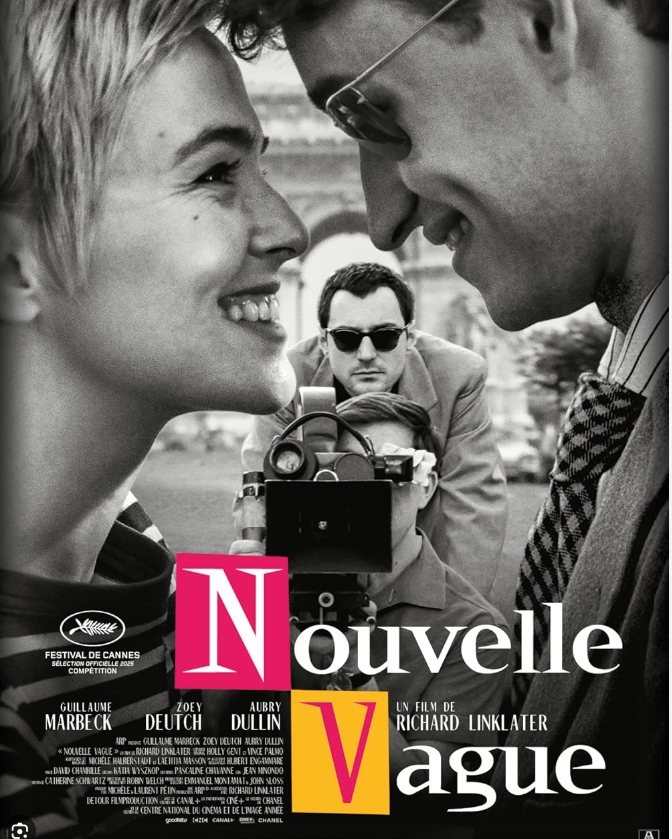
Set in 1959 Paris, Nouvelle Vague opens at a pivotal moment for French cinema: a group of young, sharp-tongued film critics-turned-aspiring filmmakers—Jean-Luc Godard (Guillaume Marbeck), François Truffaut (Adrien Rouyard), and Claude Chabrol (Antoine Besson)—are growing restless with the staid, formulaic films dominating French screens. Fresh from criticizing a lifeless studio production at a post-premiere party, Godard makes a bold pledge: he will direct a film that breaks all the rules, a work that feels alive, unscripted, and true to the chaos of real life. His inspiration comes from a chance encounter with a newspaper story about Michel Portail, a petty criminal who stole a car and fled with his American journalist girlfriend—an idea Truffaut had sketched out as a potential screenplay. With the support of producer Georges de Beauregard (Bruno Dreyfürst) and the encouragement of Italian director Roberto Rossellini (Laurent Mothe), who urges the young filmmakers to “avoid artistic artifice and shoot efficiently,” Godard embarks on a journey to make what would become Breathless—a film that would launch the New Wave into the global spotlight.
Linklater’s greatest strength here is his refusal to romanticize the New Wave legends as untouchable geniuses. Instead, he portrays them as flawed, passionate, and often chaotic young artists figuring things out as they go. Godard is not the stoic visionary of film history; he is a stubborn, impulsive perfectionist who improvises dialogue on set, argues with his crew about camera angles, and struggles to balance his artistic ideals with the practical realities of filmmaking. Marbeck delivers a career-defining performance, capturing Godard’s sharp wit, restless energy, and quiet insecurities with remarkable accuracy. Whether he is bickering with his cinematographer Raoul Coutard (Matthieu Penchinat) about using handheld cameras or waxing poetic about the power of cinema in a smoky Parisian café, Marbeck embodies Godard’s contradictions—arrogant yet vulnerable, rebellious yet desperate for validation. It is a performance that feels less like an impersonation and more like a vivid, lived-in portrait of a man on the cusp of changing cinema forever.
Zoey Deutch shines as Jean Seberg, the American actress cast as Patricia Franchini, the free-spirited journalist and love interest in Breathless. Deutch captures Seberg’s effortless charm and quiet strength, portraying her as more than just a muse—she is a collaborator, unafraid to push back against Godard’s demands and bring her own ideas to the role. Her scenes with Marbeck are electric, capturing the playful tension between Godard’s stubbornness and Seberg’s pragmatism. When Godard insists on shooting a scene in a single take without a script, Seberg responds with a mix of amusement and frustration, telling him, “You want chaos? Fine—but let’s make it meaningful.” Deutch’s performance earned her a nomination for Best Supporting Performance at the 41st Independent Spirit Awards, and it is well-deserved; she brings warmth and depth to a role that could have easily been reduced to a footnote in Godard’s story.
Aubry Dullin is equally impressive as Jean-Paul Belmondo, the charismatic actor cast as Michel Poiccard, the petty criminal at the center of Breathless. Dullin captures Belmondo’s rugged charm and laid-back swagger, channeling the actor’s iconic performance while adding his own subtle nuances. His scenes with Deutch are tender and playful, perfectly capturing the chemistry between Patricia and Michel that made Breathless such a landmark film. The supporting cast is equally strong: Adrien Rouyard brings warmth and wit to Truffaut, portraying him as Godard’s more level-headed counterpart; Antoine Besson captures Chabrol’s dry humor and pragmatic approach to filmmaking; and Bruno Dreyfürst shines as the gruff but supportive producer Georges de Beauregard, who takes a chance on Godard’s unorthodox vision despite his doubts. Together, this ensemble creates a vivid portrait of a group of artists bound by their love of cinema and their desire to break free from tradition.
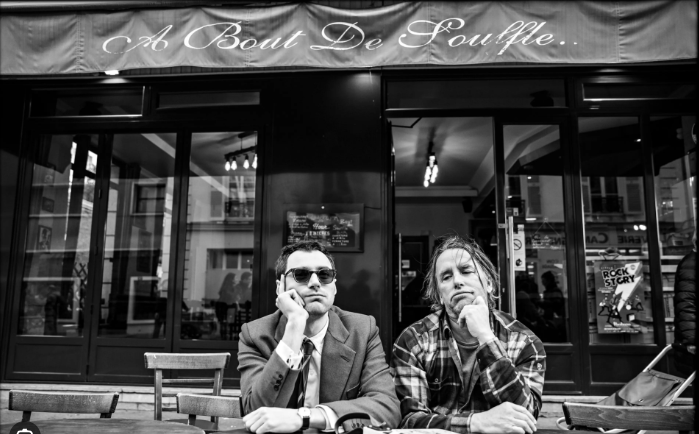
Visually, Nouvelle Vague is a masterclass in period recreation. Linklater and cinematographer David Chambille have crafted a film that looks and feels like a product of the 1950s French New Wave, using black-and-white photography, specific aspect ratios, and even occasional cigarette burns in the top right corner to mimic the look of vintage film prints. The handheld camera work, a hallmark of the New Wave, is used to great effect, creating a sense of intimacy and immediacy that draws viewers into the chaos of the Breathless set. The Parisian streets are captured with documentary-like realism, from the cobblestone alleyways of Montmartre to the bustling cafés where Godard and his colleagues debate cinema late into the night. The production design, led by Katia Wyszkop, is meticulous, recreating the look of 1950s Paris with stunning detail—from the vintage cars and clothing to the cluttered offices of Cahiers du Cinéma, the influential film magazine where Godard, Truffaut, and Chabrol got their start. Every frame feels like a love letter to the era, a testament to Linklater’s passion for the New Wave and his commitment to authenticity.
Musically, the film is equally evocative, featuring a score by Jérôme Lateur that blends jazz and classical music—genres that defined the New Wave era. The soundtrack also includes classic French chansons by artists like Juliette Greco, adding to the film’s nostalgic atmosphere. Linklater uses music to great effect, underscoring the emotional beats of the story and capturing the energy of 1950s Paris. Whether it’s a playful jazz tune playing over a scene of Godard and his crew racing through the streets of Paris to capture a shot, or a melancholic piano melody accompanying a quiet moment between Seberg and Dullin, the music enhances the film’s mood and transports viewers to another time.
What sets Nouvelle Vague apart from other historical biopics is its ability to balance humor and heart with intellectual depth. Linklater does not just recreate the events of the Breathless production; he explores the ideas and ideals that drove the New Wave movement. The film delves into the group’s rejection of “cinema of quality”—the polished, studio-driven films that dominated French cinema at the time—and their embrace of a more personal, authentic style of filmmaking. Through conversations between Godard and his colleagues, Linklater explores the New Wave’s core beliefs: that cinema should be a form of personal expression, that filmmakers should have complete creative control, and that the line between fiction and reality should be blurred. These themes are as relevant today as they were in the 1950s, making Nouvelle Vague not just a historical tribute, but a timely reflection on the power of art to challenge the status quo.
Linklater also avoids the trap of hagiography, unflinchingly portraying the flaws and conflicts within the New Wave group. Godard’s stubbornness and ego often clash with his crew and cast; Truffaut’s growing success with The 400 Blows creates tension between him and Godard; and the pressure of making a groundbreaking film takes a toll on everyone involved. These moments of conflict add depth and realism to the story, reminding viewers that the New Wave was not a seamless revolution, but a messy, collaborative effort driven by passion and imperfection. The film’s only minor flaw is its rushed ending, which glosses over the immediate impact of Breathless and the subsequent rifts within the New Wave group. However, this is a small quibble in a film that otherwise feels so fully realized and emotionally resonant.
In the end, Nouvelle Vague is more than just a biopic about the making of a classic film—it is a celebration of creativity, rebellion, and the unbreakable bond between artists who dare to dream differently. Linklater’s affection for the New Wave is evident in every frame, from the meticulous period detail to the playful, improvisational energy that permeates the film. He understands that the New Wave was not just a movement in cinema; it was a way of seeing the world—one that valued authenticity over perfection, passion over convention, and freedom over control. For cinephiles, the film is a treasure trove of Easter eggs and references to New Wave classics, from subtle nods to Truffaut’s The 400 Blows to direct homages to Godard’s signature jump cuts. For casual viewers, it is an engaging, accessible story about a group of young people chasing their dreams, flaws and all.
Guillaume Marbeck and Zoey Deutch deliver career-best performances, anchoring the film with their chemistry and depth, while the supporting cast brings warmth and wit to every scene. The film’s visual and musical elements are equally impressive, transporting viewers to 1950s Paris and capturing the spirit of a revolution that changed cinema forever. Nouvelle Vague is a film that feels both timeless and timely—a reminder that art is at its most powerful when it challenges the status quo and celebrates the joy of creation. It is a loving homage to the French New Wave, a tribute to the filmmakers who dared to break the rules, and a testament to Richard Linklater’s own status as one of cinema’s most visionary storytellers.
Final Verdict: A vibrant, witty, and deeply affectionate love letter to the French New Wave. Richard Linklater’s Nouvelle Vague captures the chaos, passion, and innovation of the movement with pitch-perfect performances, meticulous period detail, and a heart that shines through every frame. It is a must-see for cinephiles and anyone who loves stories about artists defying the odds to create something extraordinary. This is Linklater at his best—celebrating cinema with the same rebellious spirit that defined the New Wave itself.