Film Review: Disclosure Day (2026) – Steven Spielberg’s Tense, Thoughtful Sci-Fi Thriller About Truth, Trust and Global Uncertainty

Steven Spielberg has spent decades exploring humanity’s fascination with the unknown. From the childlike wonder of E.T. to the awe-struck cosmic curiosity ofClose Encounters of the Third Kind, his alien stories have always centered on connection rather than conflict. His 2026 sci-fi thriller Disclosure Day shifts that familiar tone dramatically. Trading warm optimism for tense modern paranoia, this ambitious conspiracy drama asks a deceptively simple question: what happens when humanity’s greatest secret finally breaks into public view? Equal parts chase thriller, political commentary and social allegory, the film uses alien disclosure as a mirror to examine modern institutional distrust, media chaos, and humanity’s fragile ability to cope with universal truth.
Set against a volatile global backdrop teetering on the brink of renewed international conflict, the story follows Daniel Kellner (Josh O’Connor), a sharp, disillusioned cybersecurity specialist with a history of whistleblowing. Working within the shadowy private research firm Wardex Corporation, Daniel stumbles upon a massive decades-long cover-up. Buried deep within classified archives lies irrefutable proof: extraterrestrial life has visited Earth for generations, and government agencies alongside powerful private corporations have deliberately hidden every trace of contact, crash recoveries, and non-human biological evidence from the public. Horrified by the scale of manipulation, Daniel steals encrypted drives containing the full archive, choosing to sacrifice his freedom to expose the truth.
What begins as a solitary mission quickly pulls in Margaret Fairchild (Emily Blunt), a grounded meteorologist who begins experiencing unexplained sensory phenomena and latent empathic abilities. Gradually, she realizes her childhood encounters with unexplained aerial phenomena have left her uniquely attuned to extraterrestrial presence. Her strange new gifts make her both a vital ally to Daniel and a high-value target for Wardex. As the pair form an uneasy alliance, they become fugitives hunted across the country by the corporation’s ruthless chief executive Noah Scanlon (Colin Firth), a calculating elitist who believes ordinary people are too fragile, too divided, and too chaotic to handle the truth of alien life.
Unlike most modern alien thrillers, Disclosure Day spends little time depicting extraterrestrials themselves. Instead, its true focus is on human reaction. Spielberg is less interested in the creatures from beyond the stars and far more fascinated by how humanity fractures, panics, and reorganizes when its foundational understanding of reality is shattered. As rumors leak online and fragmented footage goes viral, society spirals into disarray: conspiracy theories spread faster than facts, political factions weaponize the mystery, and global tensions escalate dangerously. The film brilliantly illustrates that the greatest threat brought by alien disclosure is not an invading force, but humanity’s own inability to process collective uncertainty.
Josh O’Connor and Emily Blunt deliver grounded, compelling lead performances that anchor the film’s high-concept premise. O’Connor’s Daniel is no glamorous action hero. He is a principled, anxious idealist grappling with the weight of what he has uncovered. His determination is balanced with genuine fear, making his whistleblower journey feel morally complex rather than one-dimensional. Blunt’s Margaret is equally layered; her quiet supernatural sensitivity never devolves into generic sci-fi spectacle. She portrays a woman coming to terms with lifelong alienation, both personal and cosmic, and her growing acceptance of her unique role in the global unfolding crisis creates the film’s most emotional and resonant beats.
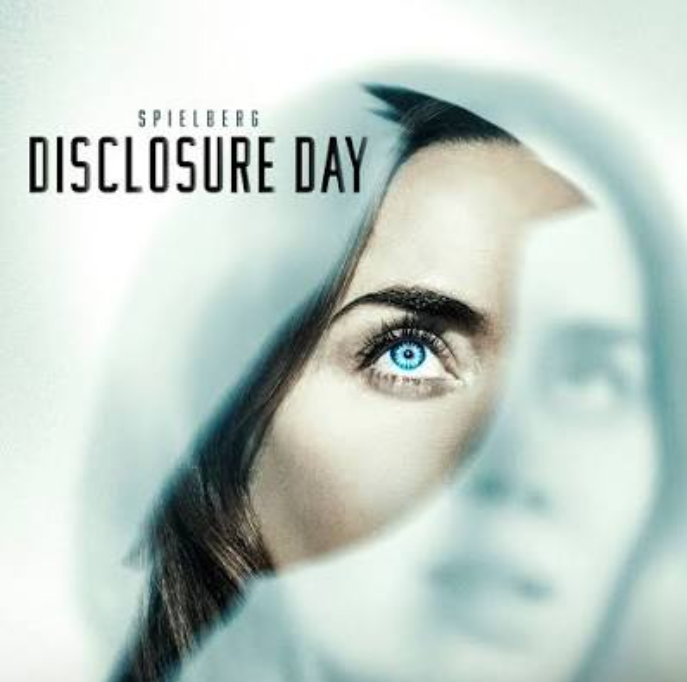
Colin Firth’s restrained villain performance elevates the film’s thematic stakes significantly. Scanlon is not a traditional evil mastermind. He genuinely believes his censorship is for humanity’s own good, arguing that secrecy protects social order and prevents mass panic. His cold intellectual arrogance creates a terrifyingly believable antagonist: a gatekeeper of truth convinced of his own moral superiority. The tense cat-and-mouse dynamic between the fugitive protagonists and the authoritarian corporation builds relentless, old-school thriller momentum, recalling the tight, intelligent suspense of classic 1990s political sci-fi.
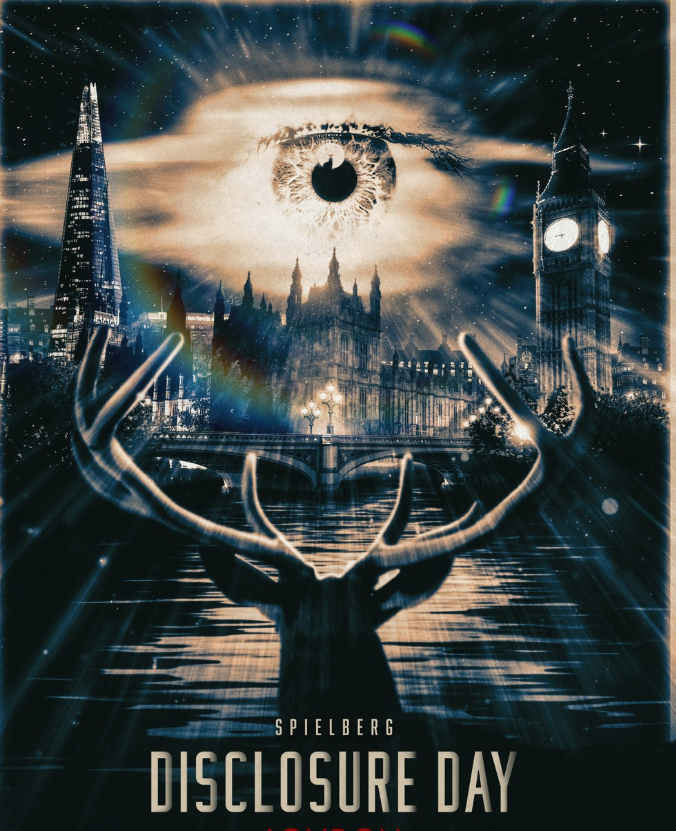
Visually, Disclosure Day showcases Spielberg’s timeless command of scale and atmosphere. The film balances sweeping aerial shots of vast open landscapes with tight, claustrophobic interior sequences, contrasting the endless mystery of the sky with the suffocating constraint of human secrecy. Spielberg uses minimal CGI restraint, favoring practical lighting, subtle atmospheric anomalies, and ambiguous shadow imagery to evoke otherworldly presence. This restraint makes the rare moments of tangible alien evidence feel far more impactful. The muted, modern color palette and crisp, clean cinematography give the film a grounded, documentary-like authenticity that amplifies its urgent realism.
John Williams’ score complements the tone perfectly, blending his signature wonder-struck melodic themes with tense, unsettling percussion. The music shifts dynamically between quiet curiosity and looming dread, mirroring humanity’s dual reaction to the unknown: innate fascination tangled with primal fear. The sound design further enhances immersion, with subtle static interference, distant atmospheric hums, and crowd chaos building a layered soundscape that feels vividly alive and unpredictable.
Where the film truly excels is its sharp, timely social commentary. Disclosure Day interrogates the modern crisis of trust: in governments, in media, in institutions, and in shared reality itself. In an era of deep polarization and rampant misinformation, the film asks haunting questions. What happens when official truth has been systematically hidden for generations? Can a fractured global society ever unite around a single transformative revelation? And who gets to decide what humanity is ready to know? Spielberg’s point is clear: secrecy breeds corruption, disclosure breeds chaos, and progress demands the courage to face uncertainty together.
If the film has flaws, they lie in its occasionally uneven pacing and tonal shifts. At 130 minutes, it balances intimate character drama, nationwide manhunt, and global societal collapse, creating occasional lulls in momentum. Some secondary subplots exploring international political tension feel underdeveloped, and the film’s finale prioritizes emotional resolution over decisive narrative closure. Additionally, viewers expecting explosive alien action or large-scale sci-fi spectacle may find the film’s thoughtful, character-driven approach surprisingly restrained.
Yet these shortcomings are intentional. Disclosure Day is not a spectacle-driven sci-fi blockbuster. It is a mature, reflective drama about humanity more than aliens. After decades of romanticizing cosmic wonder, Spielberg finally confronts the darker side of first contact: the fragility of human certainty, the corruption of institutional power, and the difficulty of collective growth. It is a surprisingly cynical yet ultimately hopeful film, suggesting that even in chaos and confusion, truth remains worth fighting for.
Final Verdict
Disclosure Day is a thoughtful, tense, socially resonant sci-fi thriller that marks a compelling evolution in Steven Spielberg’s cosmic filmography. Anchored by strong lead performances, masterful atmospheric direction, and timely commentary on truth, trust, and global division, it trades nostalgic wonder for modern anxiety while retaining the director’s signature humanistic heart. Slow-burn yet consistently engaging, introspective yet thrilling, it is one of 2026’s most intellectually ambitious mainstream genre films—a powerful reminder that humanity’s greatest obstacle to the stars is often ourselves.