Film Review: The Wizard of the Kremlin (2026) – A Chilling Study of Spin, Power, and Self-Made Authoritarianism
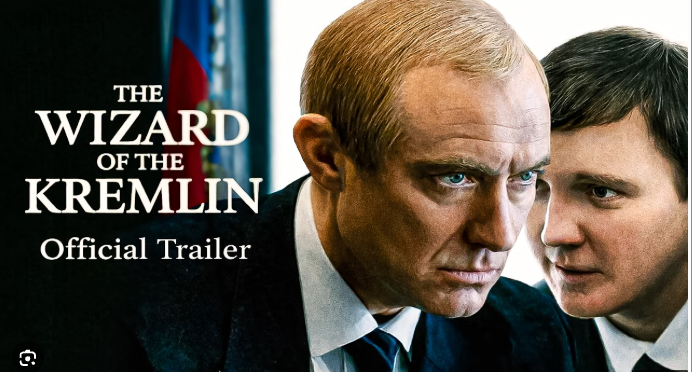
Political thrillers often prioritize high-stakes conspiracies, explosive scandals, and dramatic betrayals to grip audiences. Olivier Assayas’ sharp, cerebral 2026 drama The Wizard of the Kremlin rejects all theatrical excess. Instead of loud political spectacle, it delivers a cold, methodical dissection of modern power: how narratives are manufactured, how chaos is weaponized, and how a nation’s political identity can be entirely reshaped by one brilliant, morally hollow strategist. Based on the bestselling fictional novel rooted in post-Soviet reality, the film reimagines Russia’s turbulent transition from the collapse of the USSR to the consolidation of centralized authority. It is not a biographical drama or a history documentary, but a haunting character study of political manipulation—a quiet, unnerving masterclass in how spin becomes reality.
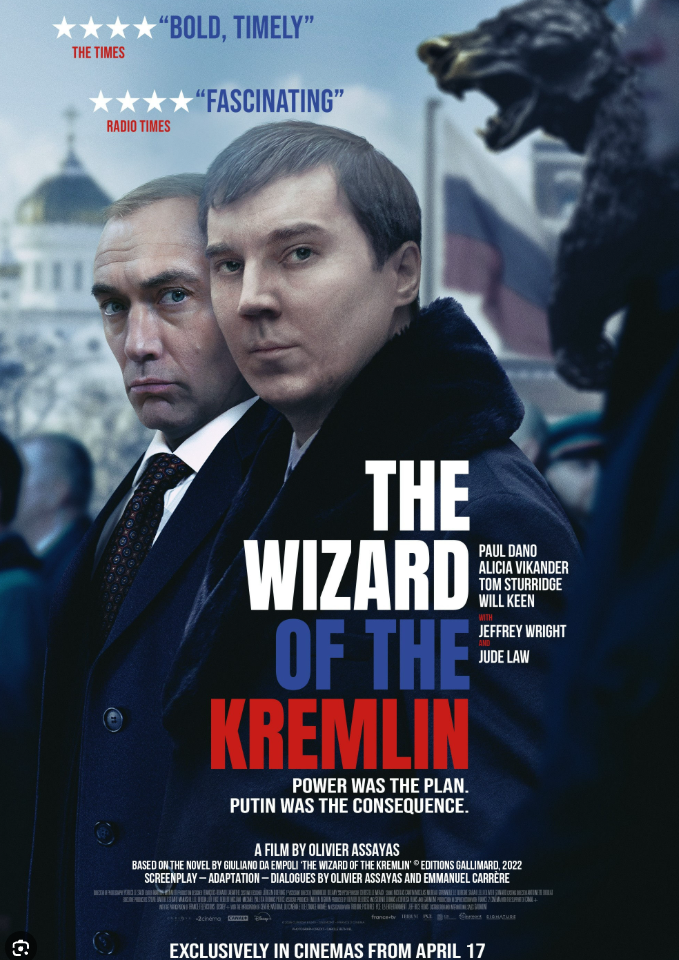
The story unfolds through the perspective of Vadim Baranov, a fictionalized political technologist played with mesmerizing restraint by Paul Dano. A reserved, intellectually razor-sharp fixer, Baranov emerges from the chaotic, lawless landscape of 1990s post-Soviet Russia. In an era where oligarchs battled for wealth and influence, state institutions crumbled, and public trust evaporated, Baranov recognizes a unique vacuum. While others chase quick profit or fleeting power, he understands the true currency of modern politics: public perception. He specializes in building narratives, neutralizing opposition, and shaping national sentiment, slowly engineering the rise of a little-known former KGB officer: Vladimir Putin, portrayed with icy stillness by Jude Law.
The film structures its narrative around a quiet, reflective present-day framing device. Decades after reshaping Russian politics, a retired Baranov sits down for an intimate conversation with American journalist Lawrence Rowland (Jeffrey Wright). What begins as a casual interview gradually unravels into a detailed confession of sorts, tracing Baranov’s journey from a behind-the-scenes strategist to the invisible “wizard” of the Kremlin. He recounts how he transformed political uncertainty into unshakable authority, turning public instability into national loyalty. Through flashbacks spanning three decades, the film maps every calculated step of his operation: how he marginalized rivals, unified fractured public opinion, and packaged authoritarian consolidation as stability and national renewal.
Paul Dano’s central performance anchors the entire film. He plays Baranov not as a typical villain or power-hungry schemer, but as a detached, almost academic observer of human weakness. Baranov is less interested in personal fame than in the mechanics of control. He views politics as a pure craft, a series of psychological puzzles waiting to be solved. Dano embodies this cold intellectualism perfectly, using minimal gestures, soft-spoken delivery, and watchful eyes to convey a man who understands everyone’s motives better than they understand themselves. There is no arrogance in his performance, only quiet certainty—a chilling reminder that the most dangerous political operators are often the calmest, most analytical minds in the room.
Jude Law’s understated turn as Vladimir Putin serves as the perfect counterpoint to Dano’s calculating wizard. Law avoids caricature and melodrama, crafting a reserved, disciplined leader who starts as a malleable bureaucratic figure and slowly hardens into an unyielding authority. The film’s most compelling dynamic lies in the push-and-pull between Baranov and Putin: the strategist who builds the image, and the leader who eventually outgrows the builder. Baranov believes he is controlling the narrative, yet he gradually realizes he has helped create a system he can no longer influence. Their relationship evolves from partnership to quiet alienation, illustrating a timeless political truth: those who build power rarely get to control where it ultimately lands.
Jeffrey Wright’s journalist character provides vital external perspective. As a Western observer attempting to decode Russia’s modern political evolution, he asks the questions the audience wants answered. His presence prevents the film from devolving into insular political theorizing, grounding dense ideological discussions in human curiosity and moral questioning. The tense, thoughtful dialogue between Wright and Dano forms the film’s emotional and thematic core, contrasting Western ideals of transparent democracy with the pragmatic, survival-driven politics of post-Soviet reconstruction.
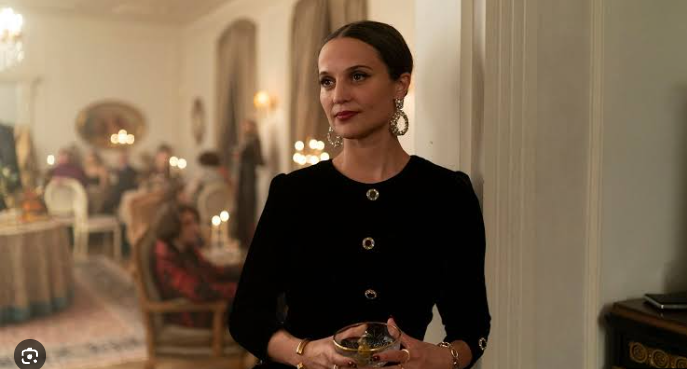
Visually, Assayas’ direction is characteristically precise and unadorned. The film’s color palette shifts masterfully with its timeline: murky, chaotic grays and browns define the lawless 1990s, while crisp, sterile blues and cold whites mark the ordered, controlled stability of the 2010s and beyond. The cinematography favors static, composed wide shots of empty Kremlin corridors, quiet office spaces, and sparse government rooms. These still frames create a subtle sense of unease, suggesting that order and calm can mask immense repression. Assayas avoids dramatic camera movement or stylized flourishes, letting the weight of dialogue and political implication generate tension instead.
The film’s greatest strength is its layered exploration of modern political propaganda. The Wizard of the Kremlin argues that contemporary authoritarianism does not rely solely on force or violence. Instead, it thrives on narrative control. Baranov’s genius lies in his ability to turn crisis into unity, dissent into fringe noise, and state consolidation into national pride. The film dissects how public truth is malleable, how repeated storytelling overrides objective reality, and how societies willingly trade chaos for security. These themes extend far beyond Russian politics, offering universal commentary on media manipulation, political polarization, and narrative warfare in the digital age.
If the film has shortcomings, they stem from its deliberate restraint and intellectual density. Assayas prioritizes political analysis over dramatic momentum, resulting in a slow-burn pace that may feel dry for viewers expecting traditional thriller suspense. Many secondary political figures blend together, and the film’s strict focus on high-level strategy leaves little room for ordinary civilian perspectives. Additionally, its balanced, neutral tone may frustrate viewers seeking overt moral judgment or clear ideological stances. Yet this restraint is precisely what makes the film so effective. It refuses cheap polemics, trusting audiences to recognize the subtle horror of normalized authoritarianism.
The Wizard of the Kremlin ultimately succeeds as one of the most intelligent political dramas of recent years. It does not offer easy answers or simplistic good-and-evil binaries. Instead, it peels back the invisible layers of modern state power, revealing how perception management shapes nations and defines history. Baranov’s tragedy is deeply human: he believes he is engineering stability, only to discover he has unleashed a system that consumes its creators. It is a sobering reminder that political pragmatism without morality always leads to self-defeat.
Final Verdict
The Wizard of the Kremlin is a sharp, haunting, intellectually rigorous political thriller anchored by career-strong performances from Paul Dano and Jude Law. Olivier Assayas crafts a nuanced, unflinching portrait of modern power manipulation, tracing how narrative strategy reshaped post-Soviet Russia into a new form of centralized authority. Slow-burn yet endlessly compelling, the film transcends its historical setting to explore timeless questions of truth, control, and political morality. It is a sophisticated, thought-provoking drama that lingers long after viewing, proving that the most powerful political magic is not supernatural—it is the quiet, human ability to rewrite reality itself.
Leave a Reply